
DJ setlist
1. John Coltrane / Naima
2. Shirley Scott & Stanley Turrentine / Flamingo
3. Bobby Hutcherson / Color Schemes
4. Betty Lou Landreth feat. Emmanuel Riggins / Emmanuel’s Way
5. Nubya Garcia / Stand With Each Other ft. Ms Maurice, Cassie Kinoshi, Richie Seivwright
6. Dora Morelenbaum / Não Vou Te Esquecer
7. Skymark / Segundas Impressões
8. JAB / Currents
9. Sade / War Of The Hearts
10. Voision Xi (喜辰晨) / Ladders (梯子)
11. Makaya McCraven / The Way Home
12. Flora Purim / Black Narcissus
13. Deniece Williams / Free
-Can you tell us about the theme or concept behind your DJ set this time?
I mixed tracks from the jazz genre that I wouldn’t usually play in a club setting. I brought a variety of records so I could take the set in a few different directions. Some had a Brazilian feel, others were more Afro-influenced, and I also tried grouping together tracks that had a Southern Hemisphere kind of mood. I even thought it might be interesting to do a set focused on just one musician. But in the end, after a lot of consideration, I settled on simply playing the tracks I love the most right now. It turned out to be an extension of the kind of set I usually play at hotels and lounges.
-Your set had a structure where you moved from older recordings to contemporary sounds, and then back to vintage again. Were there any tracks that stood out as key selections or particularly satisfying choices for you?
I chose tracks based on the feeling of the moment, so I wasn’t consciously following a strict structure from the start. But if I had to pick one key track, I’d say Flora Purim’s “Black Narcissus” (1977). The original is by Joe Henderson (1969), and although this version came out much later, Joe Henderson himself also plays on it. I really like that kind of subtle fusion—jazz compositions interpreted by Brazilian artists—so I knew I wanted to include music in that vein in this set.
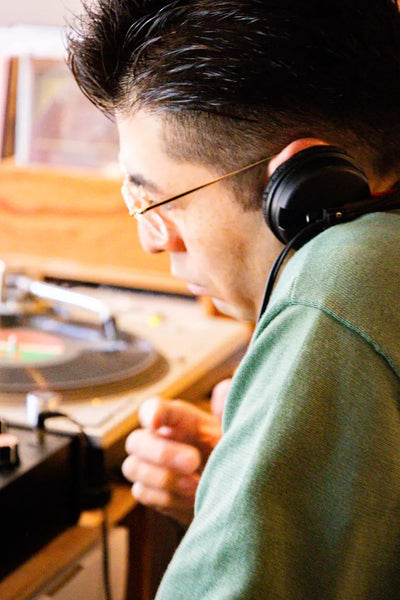
I also played Betty Lou Landreth’s “Emmanuel’s Way” (1979) on 7-inch vinyl, and that track kind of marked the transition point from older material to newer sounds. There are quite a few tracks like this—old recordings that have been reissued with a modern sound quality. They work well as a bridge between vintage and contemporary tracks, so I consciously seek them out from time to time. In my usual sets, I play both digital and vinyl formats, so I tend to think a lot about the boundaries between analog and digital, old and new, and choose tracks accordingly.

-Do you have a particular preference for playing original pressings when you DJ?
Not especially. I generally collect records and music with the intention of using them for DJing, so I prioritize sound quality and how well the track “plays out.” Sometimes when you compare an original pressing to a reissue, the reissue actually sounds better. So I don’t think original pressings are inherently superior. There have been times when I wasn’t satisfied with the sound of a reissue and ended up buying the original because it sounded better. On the other hand, like with that Betty Lou Landreth track, there are also cases where the sound quality of a reissue fits better with today’s aesthetic. It really just depends on the record.
-Do you often have opportunities to do listening-style DJ sets like this one? And when you do, is your approach any different from usual?
Yes, quite often. Not just at live events—I also host a weekly show called MONDAY TSUBAKI on the internet radio station TSUBAKI fm every Monday, where I get to play a wide range of genres. My general approach doesn’t really change, but with radio, I often have guests, so I make an effort to research their background, listen to their past mixes, and curate my selections in a way that resonates with them. If the guest is a DJ known for ambient music, I’ll lean more into ambient myself; if they’re from Brazil, I might weave in some Brazilian tracks. In contrast, when I’m selecting tracks from a completely blank slate like in this set, it can actually be surprisingly challenging.

-Can you briefly introduce the mixer you brought with you this time?
It’s the EUPHONIA rotary mixer released last year by AlphaTheta (formerly Pioneer DJ). Since it’s a rotary mixer, the tactile feel is totally different from using faders—it’s much more intuitive. Inside, it features a transmitter designed by Rupert Neve Designs, which really tightens up certain frequencies, giving the overall sound a more focused, punchy character. Since this set was being streamed, I wanted to achieve that warm analog sound, but also ensure the clarity necessary for digital platforms like YouTube. That’s why I chose this mixer. These days, it’s rare to have a setup that’s completely analog—there’s usually some digital component involved. In that sense, a mixer like this, with a hybrid analog-digital circuit, makes a lot of sense. I think it strikes a really good balance.


-How do you usually discover new music? Do you enjoy digging in record stores, or have you come to prefer buying online?
About 99% of the time, I go to physical stores. I’m not the type to research release info in advance and go in with a specific purchase in mind—I prefer checking out what’s on the shelves, listening to the records, and buying based on what I find there.
-So do you visit record shops quite frequently?
If I can go once a week, that’s ideal. Record digging is often talked about like a hobby or a fun activity, but it can actually be pretty exhausting, you know? That’s why I set specific days for digging. When I’ve decided it’s a digging day, I’ll go in the early afternoon and spend about five hours straight digging until the evening. I usually end up buying around 20 records
-Do you have a regular circuit of record shops you always visit?
When I go to Shibuya, I usually hit up HMV record shop, Disk Union, and Face Records. If I have time, I’ll also stop by Lighthouse Records to check out some house music. In Shinjuku, I typically go to HMV and Disk Union as well, and if I can, I’ll swing by Dub Store Records. ELLA RECORDS is close to where I live, so I usually go there either first or last.


-Besides DJing, what stimulates your creativity?
I’d say traveling. Going to different places for DJ gigs, meeting new people, seeing new things—that kind of experience is really inspiring. I also enjoy digging for records when I’m in regional areas.
-Do you have any favorite record shops outside of the major cities?
I really like everyday records in Kanazawa and LIVING STEREO in Fukuoka—their curation and taste in selection are great. I haven’t had many chances to visit recently, but whenever I’m in Kanazawa or Fukuoka again, I definitely want to stop by.
- Do you have any advice for those looking to start a career as a DJ?
For those who are starting out as a hobby, I’d say: just listen to as much music as you can. Especially go out to venues and listen to what DJs are playing in real-life settings. That’s really the key. We only have so much time in life to listen to music, so I hope people won’t waste that time and will really cherish every opportunity to listen deeply.
For those aiming to become professional DJs, the conversation gets a bit more serious. You have to think carefully about two things: how you’re going to make money as a DJ, and what kind of DJ you want to be—what kind of career you want to build. Balancing those two aspects has been a major theme for me over the past ten years.
That doesn’t mean you have to make a living solely from DJing. It’s totally valid to have another job for income and treat DJing as something you do without worrying about money. What’s important is finding a balance between the quality of your life and your DJ activities.
For example, if you have another job that pays the bills, the more time that job takes up, the less time you have for DJing. But on the flip side, having financial freedom allows you to buy more records.
If you go all-in as a DJ, then you can devote all your time to it—more time to dig for records, more time to express yourself. But making a living solely from DJing might mean you can’t always pick and choose the gigs you want. And if you only take high-paying gigs, you might not be able to play the music you really want to.
So you always have to be thinking about that balance between money and creativity—how much income you need to do the kind of DJing you want, or what compromises you're willing to make (or not make) in order to stay true to your artistic vision, even with limited resources. To me, that constant reflection and balance is what defines being a “professional.”
- What plans do you have for 2025?
In July, I’ll be supporting the Japan tour of BIB (who previously appeared on AFTER HOURS SESSION) and her partner MOE FURUYA, known together as BIB & MOE FURUYA. The tour is being organized by TSUBAKI fm, and I’ll be involved with that as well.
Beyond that, in July, August, and moving forward, I’ll continue organizing events and broadcasts through TSUBAKI fm, so please stay tuned and check in regularly.


